
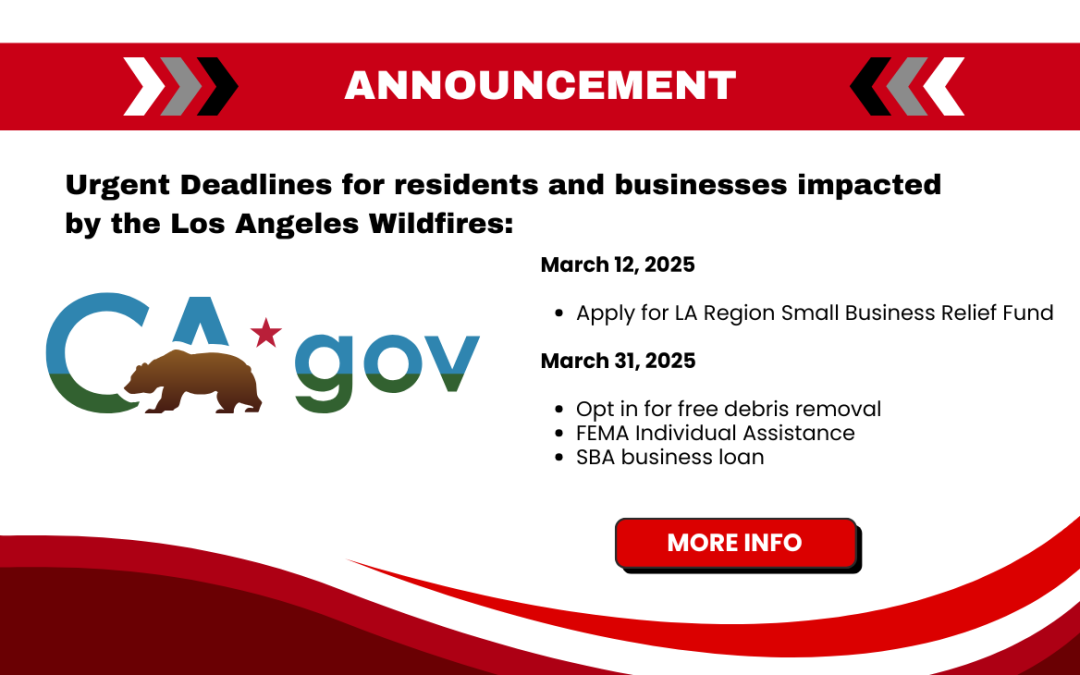
FEMA Advisory: (DEADLINE APPROACHING) – Protect Your FEMA Assistance Eligibility and Apply Now
LOS ANGELES – If your home or personal property was damaged by the Los Angeles County wildfires or straight-line winds between Jan. 7 – Jan. 31, 2025, you may be eligible for FEMA disaster assistance.
Individuals who are unsure whether they qualify for FEMA assistance, are still waiting for their insurance claim settlements, or who do not have current needs outside of their coverage but might at a later date should still apply for FEMA Individual Assistance by the March 31 deadline.
Filing an application ensures that if your insurance claim is denied, you are underinsured, or your insurance claim does not cover your losses, you may still be eligible to receive FEMA assistance.
Only one application for FEMA disaster assistance may be filed per household. If you apply and are told that you have already applied, confirm with members of your household that no one else has applied for assistance on your behalf.
If you suspect fraud, email [email protected]. FEMA’s security team will stop any fraudulent applications and investigate potential duplication, while FEMA staff will be able to assist the survivor and ensure they receive the assistance they qualify for.
Monday, March 31, is the last day to apply for FEMA disaster assistance – this deadline will not impact applications that have already been started.
How To Apply for FEMA Individual Assistance:
Online at DisasterAssistance.gov.
On the FEMA App.
By calling the FEMA Helpline at 1-800-621-3362. If you use a relay service, give FEMA your number for that service. Assistance is available in multiple languages. Lines are open Sunday–Saturday, from 4 a.m.- 10 p.m. Pacific Time.
At a Disaster Recovery Center (DRC). To locate a DRC near you, visit the DRC Locator.
Submit Debris Removal Right of Entry Forms by March 31
Debris cleanup for the catastrophic wildfires in Los Angeles County began in January. FEMA assigned the U.S. Environmental Protection Agency (EPA) and USACE to survey, remove, and dispose of debris from properties burned by the wildfires.
As part of this effort, Los Angeles County established a Debris Removal website with information and resources for fire-impacted residents to learn more about the debris clearance process. In Phase 1 of the process, which was completed on February 25, the EPA removed hazardous household materials (HHM) from private property. No action from the property owner was required for Phase 1 to be completed. HHM removal associated with properties where structural hazards precluded safe entry were deferred to USACE.
Phase 2, conducted by USACE, consists of structural debris removal and requires an ROE form completed by the property owner, which is provided on the county website and available at Disaster Recovery Centers. Free private property debris removal by USACE is only available if the eligible property owner opts in by completing and submitting the ROE form. The ROE form is an agreement where property owners accept the conditions of participation in the debris removal program and give permission for USACE to access their property for cleanup activities.
Signing up for the debris removal program via the ROE does NOT impact a property owner’s eligibility to apply for other FEMA disaster assistance If a property owner opts out of the USACE debris removal program, they become responsible for all permits, inspections and other associated debris removal requirements and costs.
Coverage for debris and hazardous tree removal may be provided through your insurance policy. For information about insurance reimbursement, visit pages 3 and 4 on the ROE form.
What is the Debris Removal Program?
The Debris Removal Program has two phases: removal of HHM followed by removal of other fire-related debris and trees that are deemed a hazard or that a certified arborist determines are dead or likely to die within five years due to the fire.
Phase 1: Removing Hazardous Materials
On January 16, teams of experts from EPA and California’s Department of Toxic Substances Control began assessing properties in the burn areas to remove any HHM that could pose a threat to human health and the environment such as lithium-ion batteries, paint, cleaners and solvents, oils and pesticides. This phase was automatic and completed at no cost to residents. EPA only removed hazardous materials. Examples of devices that contain lithium-ion batteries removed in Phase 1 and include: electric/hybrid vehicles, power tools, power banks, home alarms, drones, and tablets.
Phase 1 was completed on February 25. While most properties were cleared of HHM during Phase 1, some have been deferred to Phase 2 due to access and safety challenges. For more information, please visit: 2025 California Wildfires | US EPA
Phase 2: Debris Removal
On February 11, USACE, at the direction of FEMA, began removing fire-damaged metal, ash, and other general fire debris from residential properties. USACE will also remove foundations if property owners have opted to include foundation removal on the ROE. The collection of ROEs is a critical component of recovery operations because work cannot begin until a property owner opts into the program by submitting a completed form to the County. The ROE forms are available on the County’s website LA County Recovers.
Contact Us
If you have any questions, please contact FEMA Office of External Affairs:
Congressional Affairs at (202) 646-4500 or at [email protected]
Intergovernmental Affairs at (202) 646-3444 or at [email protected]
Tribal Affairs at (202) 646-3444 or at [email protected]
Private Sector Engagement at (202) 646-3444 or at [email protected]
#MLK Day #Kingdom Day Parade. Photo Courtesy @KayteDeioma.com and @NBC4Telemundo52.